60 Shadow Work Prompts for Beginners, Organized by Theme
60 shadow work prompts for beginners, grouped by theme, from triggers to the golden shadow, plus how to use them safely and what to do when it gets heavy.
19 October 2026 · 8 min read

In this guide
- How to use these shadow work prompts
- Shadow work prompts for triggers
- Shadow work prompts for the inner critic
- Shadow work prompts on childhood and family rules
- Shadow work prompts on projection and envy
- Shadow work prompts on people-pleasing
- Shadow work prompts on anger
- Golden shadow prompts
- Shadow work prompts for integration
- What to do when it gets heavy
- Going deeper with a guided journal
- A soft closing
A good shadow work prompt does not demand a breakthrough. It simply opens a door a little wider than you would open it on your own.
Below are 60 shadow work prompts for beginners, grouped into eight themes so you can follow whatever is most alive for you right now. Before you dive in, take a few minutes with the short guide on how to use them safely. It will make the practice gentler and far more useful.
If you are new to the idea itself, you may want to start with our beginner's guide, What Is Shadow Work?, and then come back here.
How to use these shadow work prompts
Shadow work is a self-reflection practice for noticing and accepting the parts of yourself you have learned to hide or judge. The term "shadow" comes from psychologist Carl Jung's work, but you do not need any theory to use these questions. You only need honesty and a little patience.
Set up a calm container
Choose a quiet time when you will not be interrupted. Light a candle, make tea, sit somewhere soft. Before you write, take five slow breaths and feel your feet on the floor. After you write, do the same again. Grounding at both ends keeps the practice steady.
How many prompts per session
For most beginners, one to three prompts per session is plenty. Fifteen to twenty minutes of honest writing will usually take you further than an hour of forcing it.
A simple rhythm:
- Pick one theme for the week
- Answer one to three prompts per session, a few times a week
- Leave at least a day between heavier themes, such as childhood or anger
- Revisit a prompt weeks later and notice what has changed
Write without editing
Let your answers be messy, contradictory or unfinished. You are not writing for anyone else. If a prompt does not land, skip it. If one stirs a lot, stay with it and let the others wait.
A kind note on safety
Shadow work is not therapy and is not a substitute for professional mental health care. If you are working with trauma, or if feelings come up that feel overwhelming, it is wise to pause and seek support from a qualified professional. You are always allowed to close the journal.
Shadow work prompts for triggers
Triggers are the easiest doorway into the shadow because they happen in real time. Start with something from this week.
- 1.Describe a moment this week when you reacted more strongly than the situation called for. What happened, plainly?
- 2.Where did you feel that reaction in your body, and what did it feel like?
- 3.What did you want to say or do in that moment that you held back?
- 4.When is the earliest time you remember feeling this exact feeling?
- 5.What might this reaction be trying to protect you from?
- 6.What would you need to hear from someone right now to feel calmer about it?
- 7.Which type of person or situation triggers you most reliably, and what do they have in common?
- 8.If this trigger were a messenger, what would its message be?
Shadow work prompts for the inner critic
Your inner critic often began as a protector. These prompts help you hear it without automatically obeying it.
- 9.Write down, word for word, the harshest thing your inner critic said to you recently.
- 10.Whose voice does your inner critic sound like? A parent, a teacher, someone else, or a blend?
- 11.What is your inner critic afraid will happen if it stops criticizing you?
- 12.In which area of your life is your inner critic loudest, and why there?
- 13.What would you say to a close friend who told you that same harsh sentence about themselves?
- 14.Rewrite one of your inner critic's sentences in a voice that is honest but kind.
- 15.What has your inner critic helped you achieve, and what has it cost you?
Shadow work prompts on childhood and family rules
Every family has unspoken rules. Some served you well. Some you may still be following without ever having chosen them. Go slowly with this theme.
- 16.Complete this sentence five times: "In my family, we didn't..."
- 17.Which emotions were welcome in your home growing up, and which were quietly discouraged?
- 18.What role did you play in your family? The peacemaker, the achiever, the invisible one, the funny one?
- 19.What did you learn about money, rest, or ambition simply by watching the adults around you?
- 20.What did you need as a child that you did not always receive?
- 21.Which family rule do you still follow today that you would not choose for yourself?
- 22.What trait of a parent or caregiver do you see in yourself, and how do you feel about it?
- 23.If you could give your younger self permission for one thing, what would it be?
If this theme feels especially full for you, our free seven-day starter offers a gentle on-ramp before you go further.
Free download
The Shadow Work Starter
Seven days of gentle prompts, a grounding ritual and a reflection page — a printable PDF to begin your inner work tonight.
Shadow work prompts on projection and envy
What irritates or fascinates us in others is often a mirror. These prompts help you notice what you might be seeing in someone else that also lives in you.
- 24.Think of someone who irritates you intensely. List three traits that bother you about them.
- 25.Have you ever shown any of those traits yourself, even in a small or hidden way?
- 26.Who do you envy right now, and what exactly do they have that you want?
- 27.What would it mean about you if you allowed yourself to want that openly?
- 28.What do you judge most harshly in other people? Where did you learn that it was unacceptable?
- 29.Who do you admire almost to the point of discomfort, and what quality in them draws you?
- 30.Recall a recent resentment. What did you need in that situation that you did not ask for?
Shadow work prompts on people-pleasing
People-pleasing often hides real needs, preferences and boundaries. These prompts help them come back into view.
- 31.When did you last say yes when you meant no? What were you afraid would happen if you said no?
- 32.Whose disappointment do you find hardest to tolerate, and why?
- 33.What do you believe you have to do, or be, in order to be loved?
- 34.Which of your needs do you most often set aside for other people?
- 35.Describe a boundary you wish you had held recently. What would holding it have sounded like?
- 36.What part of yourself do you hide to keep the peace?
- 37.How would your week look different if you stopped trying to keep everyone comfortable?
- 38.What would you do with your time and energy if no one's approval was at stake?
Shadow work prompts on anger
Anger is one of the most commonly exiled emotions, especially for people who learned to be "the easy one." It often carries important information about boundaries and values.
- 39.How was anger expressed, or suppressed, in your home growing up?
- 40.What story do you tell yourself about people who get angry?
- 41.What are you angry about right now that you have not admitted to anyone?
- 42.Where does anger live in your body, and what does it want to do?
- 43.If your anger could speak calmly, what boundary would it be asking for?
- 44.What injustice, big or small, still makes your blood rise? What does that tell you about what you value?
- 45.Write an unsent letter to someone you are angry with. Say everything. Then decide whether to keep it or burn it.
Golden shadow prompts
The shadow is not only difficult things. It also holds gifts you buried because they were mocked, misunderstood or simply not encouraged. This is the golden shadow.
- 46.What did you love doing as a child that you stopped doing? Why did you stop?
- 47.Which compliment do you find hardest to accept, and why?
- 48.What quality in yourself have you been taught to downplay so others feel comfortable?
- 49.Who inspires you, and which of their qualities might already live quietly in you?
- 50.If you were not afraid of seeming "too much," how would you show up differently?
- 51.What dream have you labeled unrealistic, and whose voice gave it that label?
- 52.Name one gift you have that you rarely let people see. What would it look like to share it a little more?
Shadow work prompts for integration
Integration is where shadow work becomes part of everyday life. Rather than just noticing hidden parts, you start making room for them.
- 53.Looking back over your recent writing, which pattern stands out most clearly?
- 54.Imagine a hidden part of you as a character. Give it a name and describe how it looks and feels.
- 55.Write a short dialogue with that part. Ask it what it needs, and let it answer.
- 56.What is one small, concrete way you could honor a part of yourself you have been ignoring?
- 57.Which old belief are you ready to soften or release? What will you believe instead?
- 58.What has shadow work shown you about yourself that you are grateful to know?
- 59.Write a letter to yourself from the version of you who has accepted all of their parts.
- 60.What does "being whole" mean to you now, and how might you practice it this week?
What to do when it gets heavy
Some prompts will feel light. Others will reach something you were not expecting. When a session gets heavy:
- Stop writing, even mid-sentence. The prompt will still be there tomorrow.
- Ground yourself: feet on the floor, slow breaths with longer exhales, name five things you can see.
- Drink a glass of water, step outside, or wrap yourself in a blanket.
- Write one kind sentence to yourself before you close the journal.
- Switch to something lighter for a few days, such as gentle self-love affirmations.
- Reach out to someone you trust, or to a mental health professional, if the feelings linger or feel overwhelming.
Discomfort can be a normal part of looking honestly at yourself. Feeling flooded, panicky or unable to function is a signal to pause and get support, not to push through.
Going deeper with a guided journal
These 60 prompts are complete on their own. You can return to them for months. But if you would like a structured path that carries you from noticing to integrating, without having to choose your next step each day, a guided journal can help.
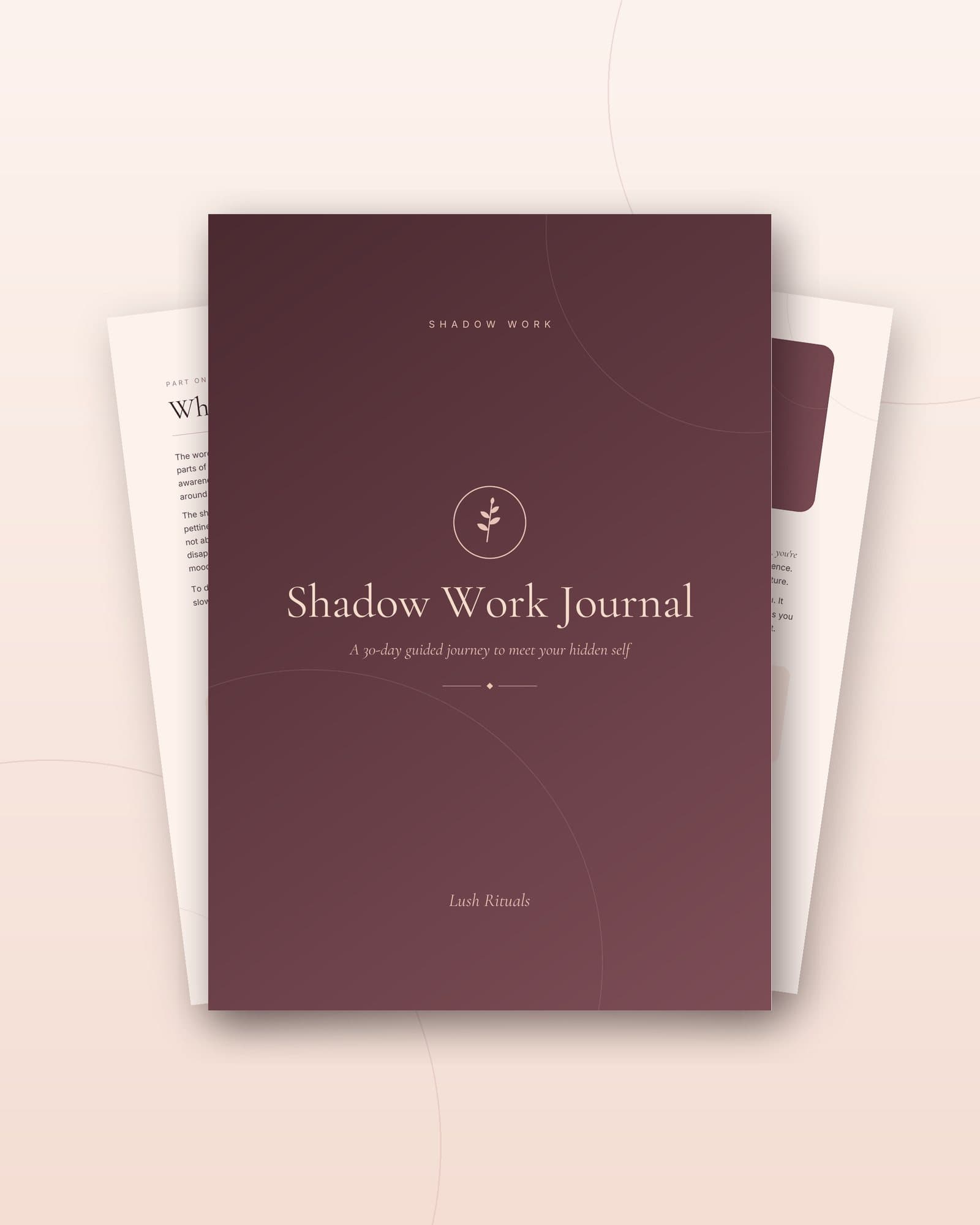
The Shadow Work Journal is a 30-day journey through five phases: Awareness, Origins, Mirrors, Integration and Return. Each day includes a short teaching, an embodied ritual, an affirmation and three prompts, along with a toolkit of trackers, worksheets and eight grounding techniques.
If you also want self-love rituals and a lunar practice to sit alongside it, The Complete Inner Journey brings together all three of our guides in one collection.
A soft closing
You do not need to answer all 60 prompts. You do not need to answer them in order, or quickly, or well. Choose one that makes you pause, light a candle, and see what arrives.
Shadow work is not about becoming someone new. It is about welcoming back the parts of you that were always there, waiting for a gentler kind of attention.
Go slowly. Rest often. And let each honest page be enough.
Continue your practice
Shadow Work Journal
A 30-day guided journey to meet your hidden self. 98 pages of teachings, rituals and prompts, with a toolkit of worksheets. Fillable & printable PDF.
- Instant download — the link arrives in your inbox
- Fill in on your tablet or print at home
- Yours to return to, again and again
The practices in this guide are for reflection and self-care. They are not a substitute for professional medical or mental health support.
Keep reading