What Is Shadow Work? A Gentle Beginner's Guide
What is shadow work? A gentle beginner's guide to meeting the hidden parts of yourself, with simple steps, safety notes and prompts to start today.
19 October 2026 · 8 min read

In this guide
There are parts of you that rarely get invited to the table. The jealousy you tidy away before anyone sees it. The anger you swallow because you are "the calm one." The ambition you play down so no one thinks you are too much.
Shadow work is the practice of gently turning toward those parts instead of away from them. Not to fix yourself, and not to dig for drama, but to see yourself more fully and stop being quietly run by what you have hidden.
This guide walks you through what shadow work is, why people practice it, how to start on your own this week, and how to keep it kind.
What is shadow work?
Shadow work is a self-reflection practice for noticing, understanding and accepting the parts of yourself you have learned to hide, deny or judge. These might be feelings, needs, traits or desires that once felt unsafe, unwelcome or "not like you."
The idea of the "shadow" comes from the work of psychologist Carl Jung. In simple terms, your shadow is everything about you that sits outside the self-image you show the world. Anything you were taught was too loud, too needy, too selfish or too sensitive tends to end up there.
The shadow is not your "bad side." It holds plenty of good things too: creativity you were told was impractical, confidence that was labeled arrogance, softness that was called weakness. Those buried gifts are often called the golden shadow.
In practice, shadow work usually looks like:
- Noticing strong emotional reactions and getting curious about them
- Journaling with honest, specific prompts
- Tracing patterns back to the rules you absorbed growing up
- Recognizing when you see your own hidden traits in other people
- Making peace with those parts and choosing how you want to live with them
What you hide does not disappear. It simply waits somewhere you can no longer see it.
Why people practice shadow work
Most people come to shadow work because something keeps repeating. The same argument with a partner. The same exhaustion from saying yes. The same sting when a friend shares good news.
When a reaction feels bigger than the moment, it is often pointing at something older. Shadow work gives you a way to follow that thread with patience instead of shame.
People often describe the practice as helping them:
- Understand their triggers instead of being ambushed by them
- Hear their inner critic without automatically believing it
- Notice which family rules they still follow without choosing them
- Feel less judgmental, of themselves and of others
- Reclaim qualities they quietly gave up
It is slow, unglamorous and deeply personal. That is part of its value.
Shadow work is not therapy
A quick, kind note before you begin. Shadow work is a reflective practice, not a treatment. It is not a substitute for professional mental health care.
If you are living with trauma, grief, or feelings that tend to overwhelm you, it can be wise to explore this work alongside a qualified therapist or counselor. And if anything you uncover feels like too much, you are always allowed to stop, close the journal, and reach out for support. Pausing is part of the practice, not a failure of it.
How to start shadow work: a simple beginner's practice
You do not need special tools. A notebook, a pen and twenty quiet minutes are enough. Here is a gentle way to begin.
1. Create a small, safe container
Choose a time when you will not be interrupted. Light a candle, make tea, sit somewhere comfortable. These small rituals tell your body that this is a protected space, which makes honesty easier.
Decide in advance how long you will write. Fifteen to twenty minutes is plenty for a beginner.
2. Ground yourself first
Before you write, take a minute to arrive. Feel your feet on the floor. Take five slow breaths, making each exhale a little longer than the inhale. Name three things you can see in the room.
Grounding before and after each session keeps the practice steady, especially on days when something tender comes up.
3. Start with a recent trigger
The easiest doorway into the shadow is something that happened this week. Think of a moment when you felt a sharp reaction. Then write about it:
- 1.What happened, described as plainly as possible?
- 2.What did I feel, and where did I feel it in my body?
- 3.What did I want to do, say or hide in that moment?
- 4.When have I felt this way before?
- 5.What might this reaction be trying to protect?
Write without editing. Spelling, grammar and neatness do not matter here. Nobody else needs to read this.
4. Look for the rule underneath
Many triggers rest on an unspoken rule, often one you learned early. "Good people don't get angry." "Needing help is weak." "Rest has to be earned." "Don't take up too much space."
Once you notice a rule, ask yourself: Who taught me this? Is it still true for me? What would I choose instead?
5. Meet the hidden part with curiosity
Imagine the part of you that felt the reaction as its own small character. Ask it what it needs. You might be surprised by how simple the answer is: to be heard, to rest, to be taken seriously.
You do not have to agree with every part of you. You only have to stop pretending it is not there.
6. Close the session with care
End with something gentle. Read back one line you are proud of writing. Place a hand on your chest. Choose an affirmation such as "Every part of me is allowed to be seen." Then blow out the candle and do something ordinary and comforting.
If you would like a little structure for your first week, our free starter has seven days of gentle prompts you can print or keep on your phone.
Free download
The Shadow Work Starter
Seven days of gentle prompts, a grounding ritual and a reflection page — a printable PDF to begin your inner work tonight.
A guided way to go deeper
Working with loose prompts is a lovely way to begin. Over time, though, many people find they want a clearer path, something that moves from noticing to understanding to actually integrating what they find, without having to design the journey themselves.
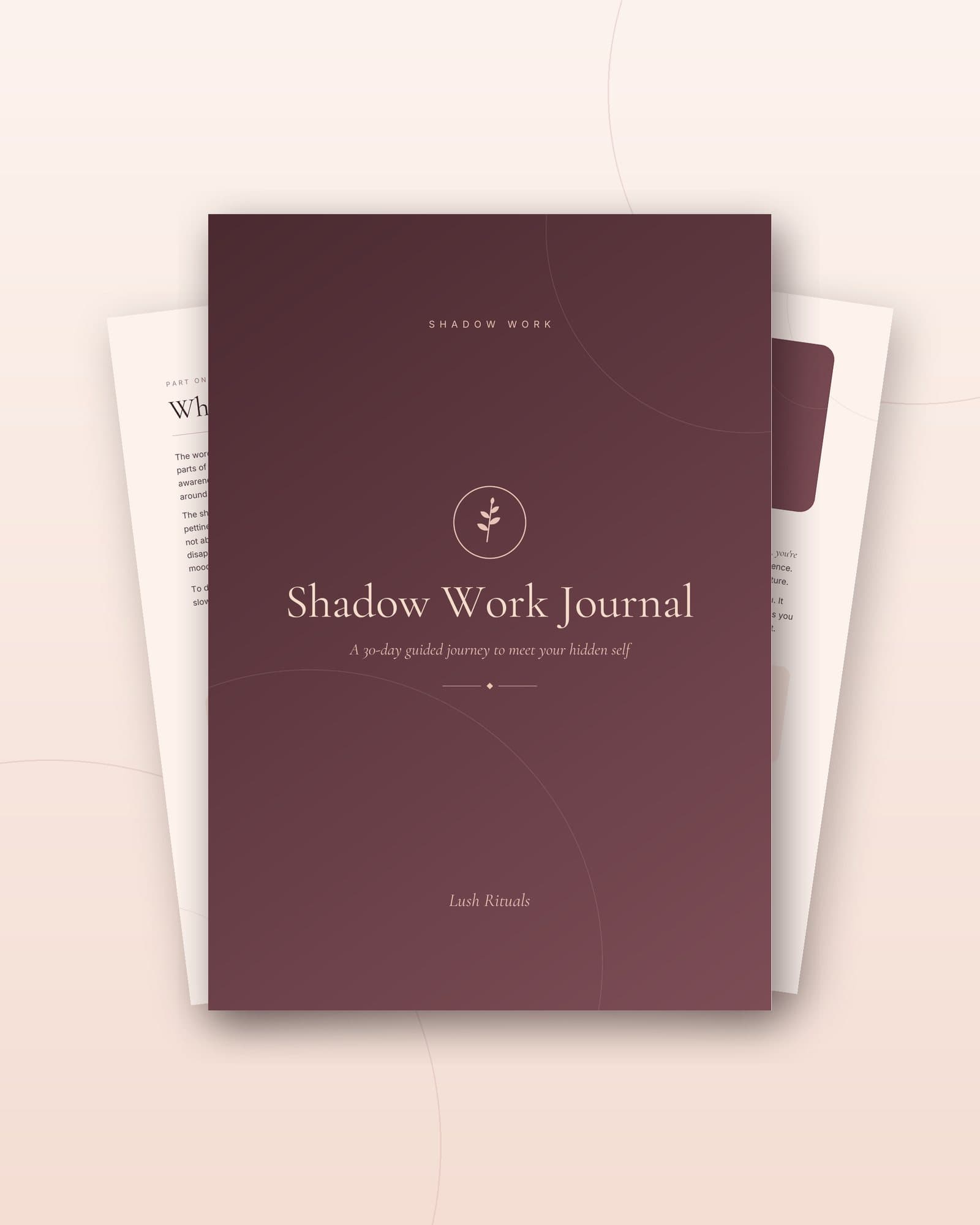
That is why we created the Shadow Work Journal. It is a 30-day guided journey across five phases: Awareness (masks, triggers, the inner critic, shame), Origins (childhood patterns and your family's unspoken rules), Mirrors (projection, envy, resentment and inherited traits), Integration (the golden shadow and inner parts dialogue) and Return (a releasing ceremony and a letter from your whole self).
Each day pairs a short teaching with an embodied ritual, an affirmation and three prompts, so you are never staring at a blank page wondering what to ask yourself.
It also includes a toolkit you can return to long after the 30 days: a trigger tracker, a feelings vocabulary, a shadow traits inventory, Dark Mirror and Golden Mirror worksheets, a parts dialogue page and eight grounding techniques. You can fill it in digitally, handwrite in GoodNotes or Notability, or print it at home.
If you want to balance the depth of shadow work with something softer, the Inner Work Bundle pairs the journal with the Self-Love Ritual Kit.
Signs your shadow is asking for attention
You do not need a crisis to start. But these everyday signals are often where the shadow shows itself:
- Outsized reactions. You feel a surge of anger, hurt or embarrassment that does not match what actually happened.
- Strong judgments. Certain people irritate you intensely, often for traits you would never allow in yourself.
- Envy. You feel a pang when someone has the freedom, attention or success you secretly want.
- Repeating patterns. Similar relationships, conflicts or burnouts keep showing up in different forms.
- A harsh inner voice. You speak to yourself in a way you would never speak to a friend.
- Feeling flat or disconnected. Parts of your energy, desire or creativity seem to have gone quiet.
None of these mean something is wrong with you. They are simply invitations to look a little closer, and good places to point your next journaling session.
Common beginner questions
How often should I do shadow work?
A few short sessions a week is a sustainable rhythm for most beginners. Daily practice can work well with a guided structure, but consistency matters more than intensity. One honest page is worth more than an exhausting hour.
Can shadow work make me feel worse at first?
It can feel uncomfortable, because you are looking at things you have avoided. Mild discomfort is normal. Feeling flooded, panicky or unable to function is a sign to pause, ground yourself and consider professional support.
Do I need to remember my childhood to do shadow work?
No. Many people have hazy memories, and that is fine. You can work entirely with the present: your current reactions, judgments and patterns. The past often shows up on its own when it is ready.
Is shadow work spiritual?
It can be, but it does not have to be. Some people pair it with candles, moon cycles and ritual. Others treat it as plain, practical journaling. Both approaches are valid. If ritual helps you, you might enjoy reading about a full moon ritual as a natural time for release.
What should I write about?
Start with whatever has the most charge right now: a trigger, a judgment, an envy, a pattern. If you want ready-made questions, our list of shadow work prompts organized by theme is a good next step.
What to do if it feels heavy
Some sessions will feel light and clarifying. Others will stir up more than you expected. When it gets heavy:
- Stop writing, even mid-sentence. You can always come back.
- Return to your body: feet on the floor, slow breaths, a glass of water.
- Move, stretch, step outside or wash your hands in warm water.
- Write one kind sentence to yourself before closing the journal.
- Reach out to someone you trust, or to a mental health professional if the feelings stay with you.
There is no prize for going fast. The deepest shadow work tends to happen slowly, with plenty of rest between the harder pages.
A gentle place to begin
You do not have to change anything today. You only have to notice. The next time you feel a flash of envy, irritation or shame, try greeting it quietly: There you are. What are you here to show me?
That small moment of curiosity is shadow work. Everything else, the journals, the rituals, the prompts, is simply a beautiful way to make room for it.
Be patient with yourself. The parts you are meeting have waited a long time. They can wait a little longer while you light the candle and find your pen.
Continue your practice
Shadow Work Journal
A 30-day guided journey to meet your hidden self. 98 pages of teachings, rituals and prompts, with a toolkit of worksheets. Fillable & printable PDF.
- Instant download — the link arrives in your inbox
- Fill in on your tablet or print at home
- Yours to return to, again and again
The practices in this guide are for reflection and self-care. They are not a substitute for professional medical or mental health support.
Keep reading